
Complete Guide to ADR Kit Requirements for Different UN Classes
ADR kit requirements for different UN classes are defined by Chapter 8.1.5 of the ADR regulations and vary based on the specific hazards presented by each class of dangerous goods. Class 1 (explosives), Class 2 (gases), Class 3 (flammable liquids) and other UN classes each require specific combinations of PPE, spill control equipment and emergency response items to ensure driver safety and regulatory compliance.
- Identify the UN class of dangerous goods you transport to determine applicable requirements
- Review ADR Chapter 8.1.5 for mandatory equipment applicable to your specific UN class
- Select appropriate PPE, including eye protection, gloves and respiratory protection where required
- Include class-specific spill containment equipment, such as drain covers and absorbents
- Ensure you carry emergency warning equipment, including warning triangles and hi-vis clothing
- Add any substance-specific items listed in the transport document’s written instructions
- Document your kit contents and establish regular inspection schedules
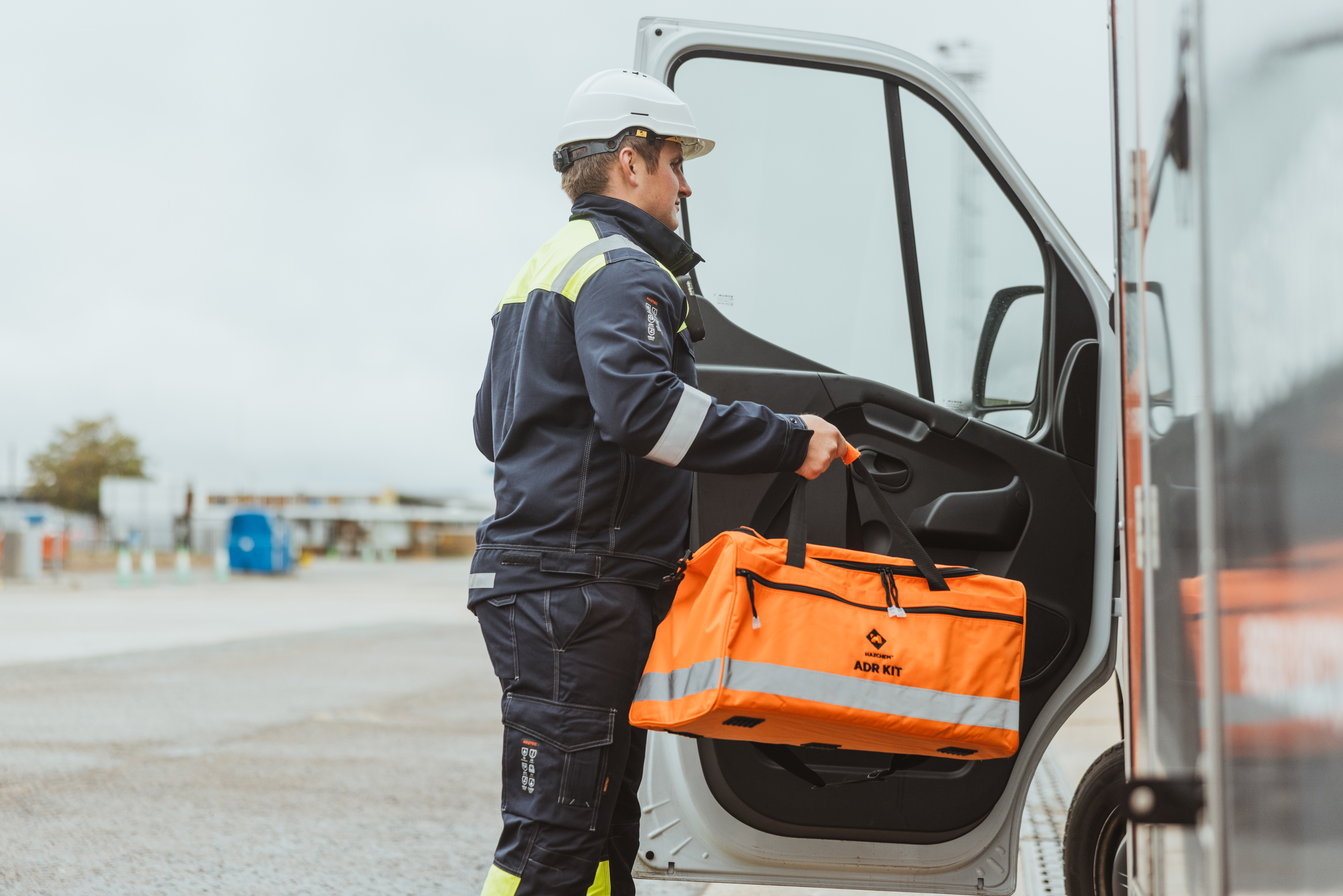
Why do ADR kit requirements vary by UN class?
The ADR agreement categorises dangerous goods into nine UN classes based on their primary hazard characteristics. Each class presents different risks during transport and in the event of an incident. As a result, the equipment needed to protect drivers and respond to emergencies differs significantly between classes.
For example, a driver transporting Class 3 flammable liquids faces different hazards than one carrying Class 8 corrosive substances. The PPE, spill control measures and emergency response equipment must match the specific risks involved. Understanding these distinctions helps fleet operators and drivers maintain compliance while ensuring genuine protection during the transport of dangerous goods.[1]
If you are unsure whether an ADR kit is a legal requirement for your operations, the answer depends on the quantities and types of goods you carry.
What are the core ADR kit requirements for all UN classes?
Before examining class-specific requirements, it helps to understand the baseline equipment that applies across all UN classes. ADR Chapter 8.1.5 specifies several items that must be carried regardless of what dangerous goods are being transported.
Standard equipment for every transport unit
Every transport unit carrying dangerous goods above exemption thresholds must carry:
- A wheel chock appropriate for the vehicle’s weight and wheel diameter
- Two self-standing warning signs (triangles or cones)
- Eye rinsing liquid, except where ADR 8.1.5.2 specifically exempts it for the applicable danger label numbers or class.
- Fluorescent warning vest or clothing for each crew member
- A portable lighting apparatus that does not produce a flame
- Protective gloves appropriate for the hazards being transported
- Eye protection, such as safety glasses or goggles
These items form the foundation of any complete ADR kit. However, additional requirements apply based on the specific UN class being transported.
Class 1: explosives
Class 1 covers explosive substances and articles, ranging from commercial blasting materials to fireworks and ammunition. Due to the severe consequences of any incident involving explosives, Class 1 transport has some of the most stringent requirements under ADR.
Beyond the standard equipment, drivers transporting Class 1 goods must pay particular attention to the written instructions provided with their transport documents. These often specify additional equipment requirements based on the specific explosive subclass (1.1 through 1.6) and compatibility group.
For detailed guidance on transporting specific Class 1 goods, our article on the carriage of fireworks under ADR covers the requirements for this common Class 1 subtype.
Class 2: gases
Class 2 encompasses compressed, liquefied and dissolved gases, including toxic and flammable variants. This class is subdivided into:
- Class 2.1: Flammable gases
- Class 2.2: Non-flammable, non-toxic gases
- Class 2.3: Toxic gases
What additional equipment is needed for Class 2 transport?
For toxic gases (Class 2.3) and certain flammable gases (Class 2.1), an emergency escape mask is required for each member of the vehicle crew where the dangerous goods bear danger label number 2.3 or 6.1, subject to the applicable ADR provisions. Additional respiratory protection may be appropriate for substances or operations falling into Class 2.1. The type of respiratory equipment depends on the specific substance being transported and is detailed in the written instructions.
When transporting LNG and other cryogenic gases, additional cold protection equipment may be necessary. Our guide to LNG driver safety explains these specific requirements in detail.
For bottled gas deliveries, which are among the most common Class 2 transport activities in the UK, requirements vary by cylinder type and quantity. Learn more about how ADR applies to the carriage of bottled gas.
Class 3: flammable liquids
Class 3 covers flammable liquids such as petrol, diesel, solvents and many industrial chemicals. This is one of the most commonly transported classes of dangerous goods in the UK.
In addition to standard equipment, Class 3 transport requires:
- A shovel (for dry powder or granular absorbent application)
- A drain seal or cover
- A collecting container (for spill containment)
These spill control items support practical spill response where appropriate to the load and operation. Absorbent material may be useful as an additional operational control, but should not be presented as a mandatory ADR 8.1.5 item.
Releases of flammable liquids pose fire and environmental risks, so operators should select spill response equipment appropriate to the goods and their risk assessment. The ADR spill requirements article provides comprehensive guidance on selecting appropriate spill control equipment.
Fuel distribution is a particularly common Class 3 activity. For specific guidance on this sector, see our article on the carriage of fuel.
Class 4: flammable solids
Class 4 is divided into three divisions covering different types of flammable solid hazards:
- Class 4.1: Flammable solids, self-reactive substances and desensitised explosives
- Class 4.2: Substances liable to spontaneous combustion
- Class 4.3: Substances that emit flammable gases when in contact with water
The key consideration for Class 4 transport is that some substances present water-reactive hazards. For Class 4.3 goods specifically, any spill response equipment must not involve the application of water. Written instructions will specify appropriate response measures.
Class 5: oxidising substances and organic peroxides
Class 5.1 (oxidising substances) and Class 5.2 (organic peroxides) require careful attention to contamination prevention. These substances can react violently with other materials, particularly combustible substances.
Equipment requirements include standard PPE plus any substance-specific items listed in the written instructions. Gloves and eye protection are particularly important as these substances can cause severe burns on contact.
Class 6: toxic and infectious substances
Class 6 covers toxic substances (6.1) and infectious substances (6.2). Both divisions require enhanced PPE to protect against exposure.
Class 6.1 toxic substances
For toxic substances, respiratory protection is often required. The specific type depends on the substance’s hazard classification and is detailed in the written instructions. Emergency escape masks are commonly specified for high-toxicity materials.
Class 6.2 infectious substances
Infectious substance transport typically requires additional containment equipment and specific disposal procedures for any contaminated materials. This is particularly relevant for medical waste and diagnostic specimen transport.
Class 7: radioactive material
Radioactive material transport falls under both ADR and specific nuclear transport regulations. Equipment requirements extend beyond standard ADR provisions and include radiation monitoring equipment and specific containment measures.
Due to the specialist nature of Class 7 transport, operators typically work with regulatory bodies to establish appropriate equipment requirements for their specific operations.[2]
Class 8: corrosive substances
Class 8 covers acids, alkalis and other corrosive materials. These substances can cause severe damage to skin, eyes and respiratory systems on contact or through vapour exposure.
Equipment requirements include:
- Chemical-resistant gloves appropriate for the specific corrosive being transported
- Eye protection (goggles providing splash protection are recommended)
- Eye rinsing liquid, subject to the applicable ADR exemptions
- Spill control equipment appropriate to the goods and operation
The choice of glove material is critical for Class 8 goods. Different corrosives require different barrier materials. Nitrile may be suitable for some acids, but inadequate for certain solvents. Always verify glove compatibility with the specific substances being transported.
Class 9: miscellaneous dangerous goods
Class 9 covers dangerous goods that do not fit into other classes but still present transport hazards. Examples include lithium batteries, environmentally hazardous substances, and elevated-temperature materials.
Standard ADR kit requirements apply. Additional equipment needs depend on the specific substance and are detailed in the written instructions accompanying each consignment.
How do you select the right ADR kit for mixed loads?
Many transport operations involve carrying multiple UN classes simultaneously. In these situations, your ADR kit must meet the requirements of all classes of goods being transported.
However, you must also consider compatibility. Some response measures for one class may be inappropriate or dangerous when another class is present. For example, water-based spill response is unsuitable when Class 4.3 (water-reactive) goods are also on board.
Our guide to different types of ADR kits explains how to select appropriate equipment for various transport scenarios, including mixed loads.
What about vehicle-specific requirements?
ADR kit requirements can also vary by vehicle type. Tankers, for instance, have additional equipment requirements compared to vans carrying packaged goods. The ADR kit requirements by vehicle type article covers these distinctions in detail.
For fleet operators managing multiple vehicle types across different UN classes, standardisation can help ensure consistent compliance. The Triplex ADR System offers one approach to achieving this.
How should you maintain and inspect ADR equipment?
Having the correct equipment is only part of the compliance picture. ADR also requires that equipment remain in serviceable condition and readily accessible.
Establish regular inspection schedules to check:
- PPE condition and expiry dates (particularly for respiratory equipment)
- Absorbent material integrity (ensure it has not been contaminated or degraded)
- Equipment accessibility (items must not be buried under cargo)
- Documentation currency (written instructions must match the goods being carried)
Our ADR compliance checklist for 2025 provides a practical framework for these inspections.
Where can you source compliant ADR kits?
Hazchem Safety has supplied ADR equipment to the dangerous goods transport industry since 1978. Our ADR product range includes complete kits configured for specific UN classes, as well as individual items for operators who prefer to build custom solutions.
We can advise on equipment selection based on your specific transport operations and help ensure your fleet remains fully compliant with current ADR requirements.
Frequently asked questions about ADR kit requirements for different UN classes
Do I need separate ADR kits for each UN class I transport?
Not necessarily. A single comprehensive kit can cover multiple UN classes if it includes all the required items for each class. However, you must ensure compatibility between response measures. For mixed loads, verify that no equipment conflicts exist between the classes being transported.
What are the ADR PPE requirements for each UN class?
Basic PPE requirements (gloves and eye protection) apply across all classes. Additional requirements vary by class. Class 2.3 (toxic gases) and Class 6.1 (toxic substances) often require respiratory protection. Class 8 (corrosives) requires chemical-resistant gloves matched to the specific substances. Our detailed guide to ADR PPE requirements covers these distinctions thoroughly.
Are ADR kit requirements the same across the UK and EU?
ADR is an international agreement, so core requirements are consistent across signatory countries. However, some nations may have additional national requirements. In Great Britain (England, Scotland and Wales), ADR is applied through the Carriage of Dangerous Goods and Use of Transportable Pressure Equipment Regulations 2009 (as amended). Northern Ireland has separate domestic regulations.
How often should the contents of the ADR kit be inspected?
There is no specific inspection interval mandated by ADR. However, good practice suggests checking equipment before each journey or, at a minimum, weekly for regularly used vehicles. Pay particular attention to expiry dates on respiratory equipment and the condition of absorbent materials.
What happens if my ADR kit is incomplete during an inspection?
Missing or defective equipment can result in prohibition notices preventing further transport until the deficiency is corrected. Enforcement officers may also issue fixed penalty notices or prosecute for serious or repeat offences. Maintaining complete, serviceable equipment protects both compliance and operational continuity.
Can I create my own ADR kit, or must I buy a pre-assembled one?
You can assemble your own kit, provided it contains all items required for the UN classes you transport. Pre-assembled kits offer convenience and assurance that requirements are covered, but custom-built kits allow you to match equipment precisely to your operational needs. Either approach is acceptable under ADR.
Disclaimer
This guide is provided for general information only and is not a substitute for the current ADR regulations, applicable UK legislation, or a suitable assessment of the dangerous goods and transport operation concerned. ADR requirements can vary depending on the substance, UN number, danger label, quantity, packaging, and type of transport. Users are responsible for ensuring that the equipment carried and all other aspects of the transport comply with the requirements applicable to their specific operation. Where there is any doubt, the current ADR regulations and appropriate competent authority guidance should be consulted. Some suggestions given in this article include additional operational controls that may be required by the nature of the goods and risk assessment beyond the minimum mandatory requirements. A qualified DGSA should be able to further help assess specific requirements.